
Why this matters
Use this hub for ROI, implementation frameworks, office workflow improvements, and full-pipeline operating models.
Short Answer
For roofing companies, the highest-probability AI front desk ROI usually comes from one workflow first: capturing, qualifying, and routing inbound demand into an FSM-connected booking and follow-up process.
That is usually a better starting point than buying a generic “AI receptionist” and hoping value appears on its own.
Roofing demand is uneven. Storm events create short bursts of heavy inbound, while retail and insurance-related jobs often require repeated follow-up before revenue is realized. In that environment, ROI is driven less by novelty and more by a few measurable outcomes:
- more calls answered or captured
- faster speed to lead after calls, forms, and missed calls
- more inspection appointments booked
- better follow-up consistency across estimates, insurance delays, and no-response leads
- fewer office hours spent on repetitive intake and status chasing
If the AI front desk does not connect cleanly to the workflow where your team books inspections, updates lead status, and hands work to sales or production, the ROI can look good in a demo and weak in day-to-day operations. For roofing buyers evaluating FSM-integrated workflows, that connection usually matters more than a long feature list.
Public evidence on this topic is still limited and mostly vendor-owned. It is useful for understanding product positioning, but it does not by itself establish roofing-specific pricing, implementation effort, or outcome benchmarks. For trade-specific context, see Roofing.
Why Roofing ROI Behaves Differently
Roofing is not a smooth, evenly scheduled trade. Front-desk ROI is shaped by three operating realities:
- Burst volume happens fast. Storms, hail events, and high-wind incidents can produce short windows of unusually high inbound demand.
- Sales cycles can run long. Inspection, estimate, insurance coordination, homeowner hesitation, and seasonality can stretch the time between first contact and revenue.
- The office is a bottleneck. Many roofing companies still rely on manual intake, callbacks, spreadsheet tracking, or fragmented CRM/FSM updates.
That means the cost of poor front-desk performance is not just missed calls. It is also:
- inspections that never get booked
- leads that cool off before the first response
- duplicate or incomplete records
- sales and production teams working from partial information
- office staff spending time on repetitive touchpoints instead of exceptions and revenue-critical work
For a roofing operator, AI front desk ROI is an operations question, not just a communications question.
What ROI Should Mean for an AI Front Desk in Roofing
A useful ROI discussion should stay tied to measurable operational leverage, not abstract automation language.
The four metrics that matter most
At minimum, roofing buyers should define ROI around:
- Answer rate: How much more inbound gets handled instead of missed or abandoned?
- Booking rate: Of handled inbound, how much converts to inspection appointments or next-step commitments?
- Speed to lead: How quickly does a new inquiry get an appropriate response?
- Cost to book jobs: Does the system reduce labor or improve conversion enough to lower the total cost of creating booked work?
A practical ROI formula
A simple working model is:
AI front desk ROI = incremental booked-job contribution + office labor redeployed - system and implementation costs
The important discipline is proving that better inbound handling actually produces more kept appointments and better pipeline movement. In roofing, that proof matters because the time between lead and revenue can be delayed.
The Workflow to Prioritize First
If you can improve only one workflow first, prioritize this sequence:
new inbound capture + qualification + booking or handoff + automated follow-up, all tied to your FSM/CRM record
That sequence creates leverage across both storm-response demand and slower follow-up cycles.
Capture every inbound, not just live calls
The first job is not to sound impressive. The first job is to lose fewer opportunities.
Your AI front desk layer should cover:
- live phone intake
- missed-call text-back or equivalent follow-up
- web form acknowledgment and routing
- after-hours inquiry capture
- basic job-intent categorization
If a homeowner calls during a storm spike and nobody answers, the value is not in a polished greeting. The value is in capturing intent, collecting enough information, and triggering the right next action without waiting for the office to catch up.
Qualify for routing, not for perfect sales discovery
Roofing companies often overcomplicate intake. The front desk does not need to run a full sales consultation. It needs to collect enough information to route correctly.
That commonly includes:
- service area fit
- issue type
- urgency
- whether the contact wants an inspection, repair, storm-related help, or status follow-up
- preferred callback window or appointment intent
The goal is to protect speed and accuracy, not to force every lead through an overly detailed script.
Preserve human handoff for high-value exceptions
The strongest ROI workflows are usually not fully autonomous. They are selective.
Human handoff still matters for:
- escalated storm emergencies
- high-value commercial opportunities
- insurance-sensitive conversations
- upset customers or complex service history
- scheduling conflicts the system cannot resolve confidently
That is why buyers should favor clear routing and escalation logic over “AI that does everything” positioning.
Storm-Response Volume Economics
Storm-response volume is where roofing front-desk weakness becomes expensive very quickly.
When inbound spikes, office teams face a hard tradeoff:
- answer live and risk incomplete intake
- let calls roll to voicemail and plan callbacks later
- pull staff from other work to triage demand
- accept lower service quality for existing customers
An AI front desk can improve that math if it helps the business:
- capture more storm-related inbound in real time
- separate urgent inspection requests from general inquiries
- create records without manual re-entry
- trigger consistent callbacks or appointment offers
- keep the queue moving after hours and during overflow periods
Where revenue leakage happens during storms
In roofing, storm-response economics are not just about “more leads.” They are about preventing revenue leakage when demand concentration is highest.
Typical failure points include:
- missed calls that never receive a timely reply
- delayed follow-up while competitors respond faster
- incomplete intake that forces rework before booking
- office overload that slows handoff to sales or production
- inconsistent prioritization of high-urgency opportunities
What to pressure-test in demos
Ask vendors to show exactly how storm-event intake is handled:
- what gets captured automatically
- how records are created
- how urgent versus routine requests are categorized
- what happens when capacity is full
- how after-hours and weekend demand is processed
If the storm workflow is vague, the ROI case is also vague.
Follow-Up Leverage Across Long Sales Cycles
Even when the phone is answered, roofing companies still lose opportunities in follow-up.
A lead may need multiple touches because of:
- homeowner availability
- inspection timing
- insurance adjuster scheduling
- estimate review delays
- weather constraints
- stalled decision-making
That is why a serious ROI model should include follow-up leverage, not just first-contact handling.
Where follow-up usually breaks down
Common failure points include:
- no response after the first missed call
- inconsistent estimate follow-up
- no reminder before inspection appointments
- status updates trapped in personal inboxes or notes
- old leads never reactivated
These are expensive because the original marketing or referral cost has already been paid. Poor follow-up wastes acquired demand.
What good follow-up automation should improve
At minimum, the workflow should support:
- immediate acknowledgment
- callback or scheduling prompts
- reminders before inspection
- re-engagement for unresponsive leads
- clean status transitions that show who owns the next action
For many roofing companies, this is where the largest operational lift appears: not from replacing office staff, but from making sure follow-up happens when humans are busy. For a broader measurement framework, see the AI Operations and ROI Hub.
Office Workload Reduction Without Losing Control
Office workload reduction is a valid ROI driver, but it has to be measured carefully.
The real question is not “How many calls can AI answer?” It is:
Which repetitive front-desk tasks can be offloaded without creating downstream cleanup work?
Work that is often worth automating
Useful workload reduction often includes:
- collecting standard intake fields
- sending routine confirmations
- answering common status or availability questions
- logging interaction details into the correct record
- initiating follow-up sequences automatically
Work that still needs human ownership
Less useful “reduction” happens when the office later has to:
- fix bad records
- merge duplicates
- re-qualify poorly categorized leads
- correct incorrect expectations
- manually reconstruct conversation history
A roofing company should count labor savings only after cleanup and exception handling are considered.
Why FSM Integration Is the Deciding Factor
For roofing companies, front-desk ROI is strongest when the AI layer connects to the system where work is actually managed.
Without that, three problems show up quickly:
- Data fragmentation: Intake lives in one place, scheduling in another, sales updates in a third.
- Delayed action: Office staff still have to copy, paste, or manually create jobs.
- Weak reporting: You can see interactions, but not whether they became booked inspections or revenue movement.
That is why FSM-integrated workflows matter more than standalone conversation volume.
What “good enough” integration should cover
Buyers should verify whether the workflow can support:
- creating or updating lead and customer records
- assigning job or opportunity types
- writing notes or summaries into the right record
- triggering follow-up tasks or sequences
- handing off cleanly to dispatch, sales, or office queues
What is often unclear and should be verified
For many vendors in this category, public material does not clearly document:
- roofing-specific workflow templates
- implementation time
- depth of FSM write-back versus one-way sync
- duplicate-contact handling
- how much admin work remains after setup
Those details should be confirmed in a live workflow demo, not assumed from homepage language.
Implementation Checklist
Roofing companies usually get better ROI from a narrow, disciplined rollout than from a broad launch.
1) Standardize intake paths first
Before launching anything, define:
- what counts as a new lead
- what counts as an existing-customer inquiry
- which job types need distinct routing
- what information is mandatory at intake
- which statuses trigger automated follow-up
If those basics are inconsistent today, AI will automate inconsistency.
2) Set clear booking and escalation rules
Document when the system should:
- offer scheduling
- request a callback window
- transfer to a human
- create a task instead of a booking
- stop and escalate because the situation is too complex
This is especially important for storm-related calls, insurance questions, and any scenario where commitments must be precise.
3) Design for after-hours and peak-volume use
Pressure-test the workflow for:
- nights and weekends
- sudden call spikes
- no-answer and voicemail scenarios
- office understaffing
- sales reps who are in the field and slow to respond
A front-desk workflow that performs only during calm business hours will underdeliver where roofing needs it most.
4) Decide what success looks like before launch
Pick a baseline for:
- missed calls
- first-response time
- inspections booked
- follow-up completion rate
- office time spent on intake and callbacks
Without a baseline, ROI turns into opinion.
Metrics That Prove or Disprove ROI
Roofing companies should review AI front desk performance in layers.
Leading indicators
These show whether the workflow is functioning operationally:
- inbound answered or captured
- average time to first response
- percentage of missed calls converted into conversations
- booking attempts made
- follow-up tasks completed on time
- handoff accuracy to office, sales, or dispatch
Conversion indicators
These show whether operations are turning into booked work:
- inspection appointments booked
- inspection appointments kept
- estimate follow-up response rate
- reactivation of dormant leads
- lead-to-appointment conversion by source
Cost indicators
These show whether the economics are improving:
- office hours spent on repetitive intake
- cost per booked inspection
- cost per qualified opportunity
- overtime or overflow labor avoided during surge periods
Revenue-linked indicators
Because roofing sales cycles can be longer, track downstream movement too:
- booked inspection to estimate rate
- estimate to sold rate
- revenue influenced by faster response or stronger follow-up
- close rates by first-response speed band
The goal is not to attribute all revenue to AI. The goal is to see whether front-desk improvements are moving the parts of the pipeline they should reasonably influence.
How Related Searches Map Back to the Same Buying Decision
Buyers often enter research through adjacent searches, but the buying logic is usually the same.
“AI front desk ROI home service businesses”
This is broader than roofing, but the core question is unchanged: does AI improve booking quality, speed to lead, and cost to book?
For roofing, add two filters:
- can it absorb storm-response bursts?
- can it support longer follow-up cycles without losing context?
“How to add AI to a home service business”
For roofing owners, the practical answer is not “start everywhere.” Start where inbound leakage is most expensive:
- inbound capture
- booking or routing
- follow-up
- reporting tied to booked work
Not content generation. Not broad back-office experimentation. Not isolated chat experiences with no operational handoff.
“ServiceTitan AI workflow automation”
If this query is part of your research, treat it as the same category evaluation: can the workflow connect intake, follow-up, and booked-job reporting inside your operating system?
The currently verified evidence here does not establish enough detail to compare roofing-specific outcomes across ServiceTitan-related AI workflows. The practical move is to verify integration depth, job-status handling, write-back behavior, and reporting in your own demo process.
What the Current Vendor Evidence Actually Helps With
The available source set is more useful for understanding vendor positioning than for declaring category winners.
Scorpion
Scorpion describes itself as an agency-led marketing platform for home service businesses and references integrations across marketing and lead-management functions. That can matter if you want AI front desk capabilities inside a broader demand-generation stack.
What the available material does not establish on its own is roofing-specific ROI inside an FSM-connected intake, booking, and follow-up workflow.
Housecall Pro
Housecall Pro appears in buyer research because it sits close to core field-service workflows. That makes it relevant to evaluate if your team wants tighter operational handoff from inbound to job management.
But the verified material here does not clearly establish roofing-specific AI front desk ROI, implementation effort, or the exact workflow depth needed to support this use case. Treat it as a market example to investigate, not as a proven default recommendation.
Final Recommendation
For roofing companies with bursty inbound, long follow-up cycles, and a core system already used for booking and status management, the strongest starting hypothesis is an FSM-integrated inbound and follow-up workflow, not a generic AI receptionist.
That direction is commercially sensible because it targets the places where roofing companies most often lose money:
- missed or poorly handled surge demand
- slow first response
- inconsistent follow-up across long sales cycles
- office overload that delays booking and handoff
If a vendor cannot clearly show how its workflow ties inbound capture to booking, record updates, follow-up, and reporting, the ROI case is incomplete no matter how polished the AI experience sounds.
Use these four buyer checks:
- Does it capture more real demand during storm spikes and after hours?
- Does it improve booking and follow-up quality, not just answer volume?
- Does it reduce office workload in a way that sticks after cleanup and exceptions?
- Does it connect tightly enough to your FSM or CRM to prove booked-job economics?
If your bottleneck is mainly missed inbound, delayed follow-up, and office overload, this workflow is usually the right place to start. If your bigger problem is weak lead generation, limited field capacity, or an unstructured back office, ROI may depend on fixing those constraints first.
For trade-specific operating context, see Roofing. If you want to compare your process against one AI front desk implementation model, Get Your Free AI Front Desk outlines an approach and the workflow questions worth testing in demos.
Supporting visuals
Visual proof and context
Screenshots and images that support this article, with sources noted.
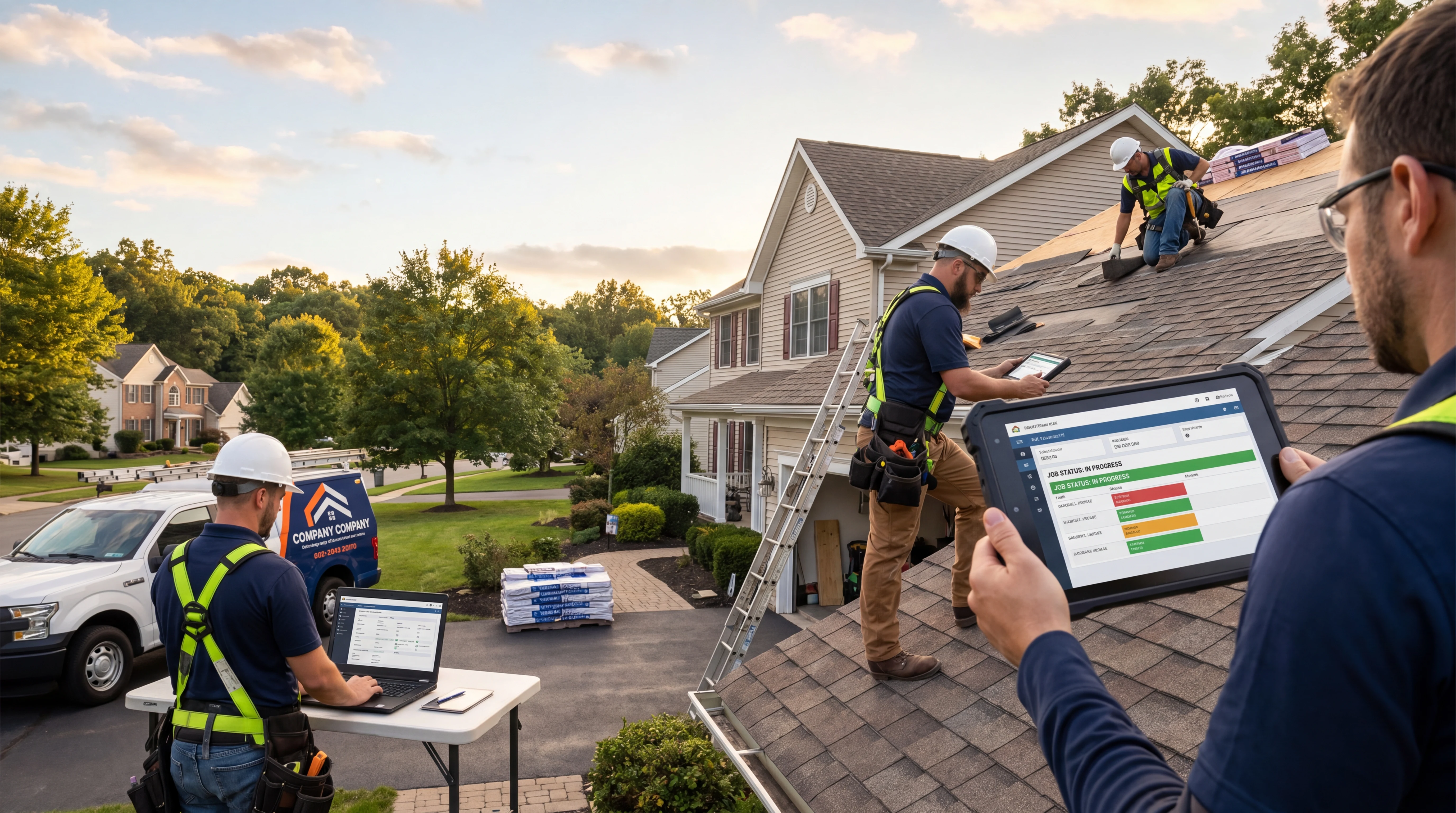
Workflow context for the article topic
Generated scene
Frequently Asked Questions
Sources