
Why this matters
Use this hub for ROI, implementation frameworks, office workflow improvements, and full-pipeline operating models.
Short Answer
For most landscaping companies, the highest-ROI AI front desk deployment is not a broad “AI assistant” rollout. It is a narrower, FSM-integrated workflow that does three things reliably:
- answers and captures quote requests fast,
- books the next step without delay, and
- pushes clean job data into the system your team already uses for follow-up.
That is usually the strongest starting point because landscaping revenue is often won or lost between the first inquiry and a scheduled estimate. If AI improves response speed but does not create a usable record, trigger follow-up, and support booked-job throughput, the ROI case weakens fast.
For buyers evaluating AI front desk ROI for landscaping companies, the practical recommendation is to prioritize quote intake and estimate scheduling tied to field-service operations rather than a standalone answering layer. The commercial logic is straightforward: landscaping ROI usually comes from quote-response economics, seasonal staffing leverage, and booked-job throughput.
Why Landscaping ROI Looks Different
Seasonality compresses the response window
Landscaping has an office bottleneck that gets worse when demand spikes. Spring surges, storm cleanup, recurring maintenance changes, enhancement work, irrigation issues, and one-off estimate requests do not arrive in a smooth pattern. They hit the office in clusters.
That matters because front-desk ROI in landscaping is not just about answering more calls. It is about sorting demand quickly enough to protect the calendar, keep estimators productive, and prevent good opportunities from stalling.
Estimate scheduling is often the revenue hinge
A missed or delayed response can create several forms of loss:
- the lead goes to another company,
- the estimate never gets scheduled,
- the office team spends time on back-and-forth that should have been structured intake,
- crews end up with weaker route density or inconsistent booked work,
- managers spend peak-season time fixing admin gaps instead of running operations.
In that environment, AI front desk value depends on whether it improves operating flow, not whether it sounds impressive in a demo.
Where ROI Actually Comes From
Faster speed to lead
The first lever is response speed. If a prospect requests a quote after hours, during lunch, or during a seasonal spike, an AI front desk can capture details immediately and move the customer toward a booked estimate or qualified next step.
More booked follow-up
The second lever is follow-up completion. Many offices are not losing leads because no one answered once. They are losing them because no one consistently finished the estimate-scheduling process. AI can help when it automates the handoff, reminder, or booking action instead of leaving the inquiry in a generic inbox.
Lower office staffing pressure
The third lever is staffing efficiency. During peak periods, even strong CSRs can become the bottleneck. If AI handles repetitive intake, call routing, and initial qualification, the existing team can spend more time on exceptions, customer issues, and schedule changes that actually require judgment.
The ROI headline is not “AI saved time.” It is “more inquiries became booked jobs without the office scaling headcount at the same rate.”
The Workflow to Prioritize First
Start with inbound quote capture and estimate scheduling
If you automate one landscaping workflow first, make it new inbound quote request → qualified intake → estimate booking or callback assignment → follow-up completion.
This workflow has the clearest path to ROI because it connects demand generation to revenue operations. It also creates a measurable before-and-after comparison, especially when built inside FSM-integrated workflows.
Capture operations-ready details, not just contact info
The AI front desk should collect the information your office already needs, including:
- customer name and contact details,
- property address,
- service type requested,
- timing or urgency,
- whether the customer is new or existing,
- any site details needed for routing or estimate prep.
For landscaping, service type matters more than many buyers expect. Lawn maintenance, design-build, cleanups, irrigation, hardscape, and seasonal services can require different next steps. If the AI layer cannot distinguish those paths cleanly, the office still has to rework the lead later.
Apply triage rules before booking
Not every landscaping inquiry should go straight to the calendar.
Some requests need disqualification. Some need clarification. Some can be booked for an estimate immediately. Others may fit recurring-service territories better than one-off dispatch. A useful AI front desk should help answer questions like:
- Is this in the service area?
- Is this the type of work the company wants?
- Does this require a site visit?
- Should this become an estimate appointment, a callback task, or a routed office review?
Push the record into the system of record
The ROI jump usually happens when qualified inquiries become scheduled activity without manual delay. If the AI layer captures information but still leaves the team to re-enter data and chase every lead manually, the gain is only partial.
Quote-Response Economics: The Core ROI Case
Landscaping buyers should evaluate AI as a booking economics decision
Most owners can understand AI front desk ROI by looking at quote-response economics.
When a prospect asks for an estimate, the office has a short window to establish responsiveness and professionalism. The AI front desk does not need to “sell” the job on its own. It needs to keep that lead from going cold and move it toward a scheduled next step.
A practical ROI model starts with five questions:
- How many inbound quote opportunities arrive per week?
- How many currently wait too long for response?
- How many never become scheduled estimates?
- What is the average value of a booked job or recurring account?
- What front-office labor is currently spent on repetitive intake and callback attempts?
Use a simple formula first
Even without claiming a universal conversion lift, you can frame the business case:
Incremental ROI = additional booked jobs from faster response + labor avoided or deferred – total system and implementation cost
That keeps the discussion tied to booked work instead of generic AI claims. For a broader measurement framework, see the AI Operations and ROI Hub.
Seasonal Staffing Leverage Matters More Than Many Buyers Expect
Peak-season demand exposes office bottlenecks
Landscaping companies often feel the need for front-desk support most during the exact periods when hiring, training, and retaining office help is hardest. That is why seasonal labor pressure makes AI ROI easier to quantify.
If spring demand spikes, the office usually lands in one of four scenarios:
- existing staff absorbs the load and response quality drops,
- managers step in and higher-value work gets delayed,
- temporary staffing is added and quality varies,
- leads are answered inconsistently and revenue leaks out.
The strongest gain may be deferred hiring, not direct labor savings
An AI front desk can change that equation if it absorbs repetitive intake and keeps the estimate pipeline moving. The value is not only lower labor cost. In many cases, the larger value is avoiding the need to add office capacity immediately while preserving booking quality.
This matters most for landscaping teams with:
- strong seasonal peaks,
- frequent after-hours inquiries,
- lean office teams,
- multiple service lines,
- route-based field operations that depend on steady scheduling discipline.
Booked-Job Throughput Is the Metric That Keeps You Honest
Answer rate is useful, but it is not enough
A lot of AI front desk conversations get stuck at the wrong layer. Answer rate matters. Lead capture matters. But if you want a serious ROI decision, focus on booked-job throughput.
Booked-job throughput means the number of qualified inbound opportunities that move through intake, follow-up, scheduling, and into the work pipeline without avoidable friction.
Throughput ties front-desk automation to actual output
Why this metric matters:
- a fast answer that produces bad data creates rework,
- a captured lead without booked follow-up is not real pipeline,
- a scheduled estimate that never gets confirmed still consumes office effort,
- a disconnected system can shift work from one person to another without producing more revenue.
For landscaping companies, throughput is the right lens because it ties front-desk automation to actual operational output. If AI improves throughput, the ROI conversation becomes stronger and less theoretical. This is also the same operating lens used throughout the AI Operations and ROI Hub.
What to Verify in an FSM-Integrated Workflow
Public evidence for this category is still thin and largely vendor-owned. Treat named products as examples from the current evidence set, and verify pricing, integration depth, setup scope, booking logic, and handoff behavior in a live demo before treating any option as a proven fit.
Data handoff to the system of record
You need to know whether the AI front desk creates a usable customer record, attaches notes correctly, and triggers the next action in your FSM or scheduling environment.
If your team still has to re-enter names, addresses, and request details, the workflow loses much of its leverage.
Scheduling logic for estimates and callbacks
Landscaping teams often need different appointment logic for:
- estimate visits,
- service calls,
- recurring maintenance inquiries,
- enhancement upsells,
- irrigation or seasonal specialty work.
Verify whether the workflow supports those distinctions or whether everything becomes a generic “lead” that still needs manual sorting.
Service area and qualification rules
A practical AI front desk should respect service area, service mix, and qualification rules. Otherwise, the office gets faster intake but not better intake.
Ask whether the workflow can apply rules around:
- ZIP codes or territory,
- minimum job size if relevant,
- commercial vs. residential routing,
- existing-customer priority,
- required estimate type.
Escalation when AI should not decide
Not every landscaping conversation should be automated end to end. Buyers should verify when the system hands off to a person and how that handoff occurs.
This is especially important for:
- upset customers,
- billing disputes,
- complex design-build inquiries,
- weather-related schedule changes,
- multi-property commercial requests.
Vendor Examples From the Current Evidence Set
Scorpion
Scorpion describes itself as an agency-led marketing platform for home service businesses, and its home-services positioning references advertising and CRM-related integration. That may be relevant if your main problem is demand generation plus lead handling in one motion. A landscaping buyer still needs to verify how far that extends into field-service workflow, estimate scheduling, and operational handoff.
Housecall Pro
Housecall Pro describes itself as software for home service businesses. For landscaping owners, that kind of platform positioning can matter if you want the AI front desk closer to job, schedule, and customer workflow. You should still confirm the exact intake, booking, and routing behavior for landscaping-specific estimate flows, along with any setup and integration limits.
What the comparison actually tells buyers
The useful takeaway is not “pick one of these brands.” It is that buyers should separate two questions:
- Is the platform primarily oriented around marketing and lead generation?
- Does the workflow actually support the operating path from inquiry to booked job?
If those answers do not line up with your real bottleneck, the ROI case can look better on paper than in production.
Implementation Checklist for Landscaping Owners
Define the exact job types in scope
Start narrow. Choose one or two service categories first, such as maintenance estimates or cleanup requests. That makes ROI easier to measure and reduces process confusion.
Set booking and handoff rules
Document what should happen for:
- qualified estimate requests,
- out-of-area inquiries,
- after-hours calls,
- existing customers,
- urgent service issues,
- jobs requiring manual review.
Connect intake fields to operations
Make sure the information collected up front is exactly what schedulers or estimators need later. If the AI captures marketing-friendly data but not operations-ready data, the office will still need to redo the work.
Establish a human exception path
Your team should know when to intervene, who owns exceptions, and how fast follow-up must happen after escalation. For landscaping-specific workflow context, the Landscaping page outlines the operating environment these rules need to support.
Metrics to Track From Day One
Response speed
Track how quickly inbound leads get an initial response or acknowledgment before and after implementation.
Estimate booking rate
Measure what percentage of qualified quote inquiries become scheduled estimates or committed callbacks.
Follow-up completion rate
Track whether promised follow-up actually happens. This is where many offices discover the real ROI opportunity.
Booked-job throughput
Measure how many inbound opportunities reach a booked state with less manual intervention and fewer delays.
Office load
Track call volume handled, callback backlog, and whether the office can maintain service levels during seasonal peaks without adding equivalent staffing pressure.
How Related Queries Map Back to the Same Buying Decision
“AI front desk ROI home service businesses”
This broader query still points to workflow economics. Across home services, ROI is strongest when AI improves speed to lead, booking quality, and staff leverage. Landscaping adds heavier seasonality and more estimate-driven intake patterns, but the core buying decision is the same.
“How to add AI to a home service business”
The wrong answer is “add AI everywhere.” The better answer is: add AI first where the business loses money through delay, inconsistency, or administrative bottlenecks. In landscaping, that usually means quote handling and scheduled follow-up, especially when paired with FSM-integrated workflows.
“ServiceTitan AI workflow automation”
Even when buyers start from a branded workflow-automation query, the evaluation standard should stay the same. Ask whether the AI layer creates cleaner intake, better booking outcomes, and stronger operational handoff inside the system of record. Brand familiarity does not replace workflow verification.
Common Buying Mistakes
Buying for call coverage only
If you solve call answering but not booked follow-up, you may improve appearance more than outcomes.
Automating too many services at once
Landscaping service lines can behave very differently. A phased rollout is usually easier to control and evaluate.
Ignoring office rework
Some systems capture leads quickly but create more cleanup work later. That can cancel out a large share of the gain.
Tracking the wrong success metric
If the team cannot say what “better” looks like in scheduling and job creation, the rollout will drift into vague satisfaction metrics instead of booked-job terms.
Final Recommendation
For landscaping companies evaluating AI front desk ROI, the strongest starting point is usually an FSM-integrated quote intake and estimate-booking workflow rather than a broad automation rollout.
That is the right fit when your business is losing revenue in the gap between inquiry and scheduled follow-up, when seasonal demand is stressing the office, or when managers are absorbing admin work that should be handled by a repeatable intake process.
The recommendation becomes weaker if your main bottleneck is not quote handling. For example, if lead volume is the real issue, a marketing-led platform may deserve a separate evaluation. If your existing software already handles intake and scheduling well, the question is whether an AI layer will remove meaningful friction or just add another tool.
Before buying, verify five checks:
- Can it capture the right details for landscaping work?
- Can it apply qualification and service-area rules?
- Can it book or route the next step cleanly?
- Can it write usable records into the system your team already runs on?
- Can it reduce office strain without creating hidden cleanup work?
If those answers are yes, the ROI case is usually clearer than a generic feature comparison. For a closer look at this operating model, see Landscaping, review FSM-Integrated Workflows, or request a workflow review at Get Your Free AI Front Desk.
Supporting visuals
Visual proof and context
Screenshots and images that support this article, with sources noted.
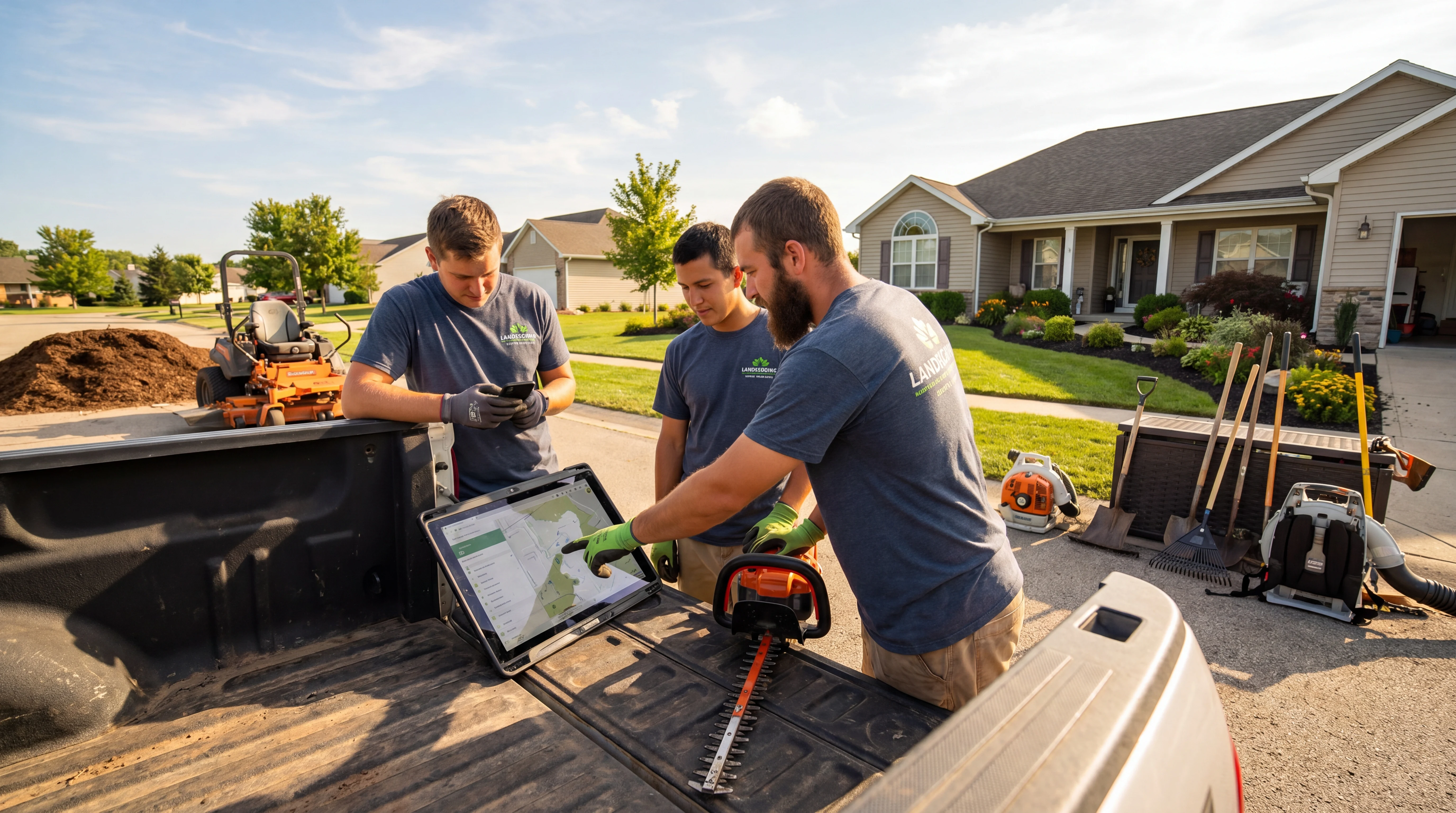
Workflow context for the article topic
Generated scene
Frequently Asked Questions
Sources