
Why this matters
Use this hub for ROI, implementation frameworks, office workflow improvements, and full-pipeline operating models.
Short Answer
For most plumbing companies, the strongest ROI case for an AI front desk is not “replace your CSRs.” It is capture more inbound demand, book more of the work you already paid to generate, and reduce low-value office workload by tying intake to your operating workflow.
For that reason, the highest-priority use case is usually FSM-integrated intake and booking: answer missed or overflow calls, qualify the job, collect usable service details, and pass the outcome into dispatch or customer records without creating more cleanup than it saves. If you need a category overview of that operating model, start with FSM-integrated workflows.
Three metrics should drive the business case:
- Answer-rate impact: fewer missed emergency, same-day, and high-intent service calls
- Booked-job lift: more answered inquiries converted into scheduled jobs with usable notes
- Office workload reduction: less manual intake, fewer callbacks for missing information, and lower admin time per booked job
The verified evidence set for this topic is limited and leans heavily on vendor and competitor positioning pages rather than independent benchmarks. That means buyers should be cautious with exact claims about pricing, integration depth, deployment time, or comparative performance, and should evaluate options based on workflow fit and measurable operating leverage instead of generic AI feature lists.
Why plumbing ROI is different from generic call-answering ROI
A plumbing call is rarely “just a call.” It often includes urgency, address validation, service classification, customer status, and whether the job can be routed profitably.
That is why a generic “we answer 24/7” claim is not enough to support a purchase. The real question is:
Does the AI front desk improve revenue capture without adding dispatch friction?
For plumbing companies, that matters because:
- Urgency is common. Water leaks, drain backups, no-hot-water calls, and shutoff issues often need fast triage.
- Bad intake creates downstream cost. Wrong job type, incomplete notes, or missing address data can slow dispatch and waste technician time.
- The office is already stretched. Even teams with decent call coverage may still lose time on repetitive scheduling, rescheduling, confirmations, and basic service questions.
For broader trade context, see the Plumbing industry page.
What AI front desk ROI should actually include
A credible plumbing business case should go beyond labor savings. In most offices, the return comes from a mix of revenue capture and efficiency improvement.
Revenue capture
This is the upside from answering calls and messages that would otherwise be missed, delayed, or abandoned.
Booked-job lift
This is the upside from turning answered inquiries into scheduled jobs more consistently and with fewer intake errors.
Office efficiency
This is the time and process value created by reducing repetitive intake work, after-hours handling, call tagging, and manual follow-up.
If a vendor pitch focuses only on “AI answers your phones,” the model is incomplete. In plumbing, the larger value often comes from better answer coverage plus a cleaner handoff into scheduling.
Trade-specific operating context for plumbing companies
Plumbing businesses often have the right operating conditions for front-desk automation to pay off—if the workflow is designed well.
Demand arrives in bursts
Morning overflow, lunch-hour callbacks, after-hours emergencies, and weather-related spikes can overwhelm even a capable office team. That makes inconsistent answer rates common.
Not every call needs the same handling
Some calls need immediate dispatch, some need scheduling, and some need simple triage before a human steps in. An AI front desk does not have to solve every scenario to generate value. It has to handle the repeatable share reliably.
Booking quality matters as much as booking volume
A bad booking can cost more than a missed one if it leads to a mismatch between the problem described and the technician sent, or if it forces a costly reschedule.
That is why plumbing buyers should not evaluate this category on answered-call volume alone. The better question is:
How many qualified, correctly routed, properly documented jobs can it help produce?
The workflow to prioritize first
If you are building a numbers-first case, start with AI front desk intake tied to your FSM workflow.
The goal is simple:
- Capture the inbound call or message
- Identify the customer and service need
- Gather minimum viable dispatch data
- Book or route according to business rules
- Write the outcome into the operating system your team already uses
That workflow is commercially stronger than a broad “AI office assistant” rollout because it ties directly to measurable outcomes. For a neutral overview of this workflow category, see FSM-integrated workflows.
Why this workflow usually wins first
It connects the three main ROI levers in one chain:
- better answer coverage
- higher booking conversion
- less manual office handling
What minimum viable plumbing intake should capture
Before taking any ROI claim seriously, verify that the workflow can reliably collect:
- customer name
- phone number
- service address
- basic problem description
- urgency level
- preferred appointment timing
- existing customer status, if available
- handoff notes that dispatch can actually use
What to avoid in phase one
Avoid leading with workflows that sound advanced but are harder to monetize early, such as broad knowledge-base conversations or long-form service education. Those may matter later, but they are usually weaker than intake and booking as a first ROI case.
How answer-rate impact drives the business case
For plumbing, answer-rate impact is often the clearest path from missed demand to recovered revenue.
If your team misses calls after hours, during overflow periods, or during CSR handoffs, an AI front desk may create value before you even count deeper efficiency gains.
The logic is direct:
- more calls answered
- more opportunities retained
- more jobs booked
- less wasted marketing spend on unanswered demand
This matters even more if you already invest in lead generation. Scorpion describes itself as an agency-led marketing platform for home service businesses, which helps illustrate a practical point: many home service companies already spend heavily to generate inbound demand. If inbound handling breaks, marketing ROI weakens too.
That does not prove a specific answer-rate uplift for any vendor. It does show why plumbing buyers should connect front-desk ROI to lead-capture economics, not just staffing relief.
A simple answer-rate formula
Use this framework:
Recovered calls × booking rate × average gross profit per booked job = revenue-side upside
Then compare that upside against:
- software cost
- implementation cost
- integration effort
- management overhead
- residual human QA work
If any of those inputs are unclear, ask for them directly instead of filling the gap with assumptions.
Booked-job lift matters more than answered-call volume
An answered call matters financially only if it becomes a valid next step.
That is why booked-job lift should sit at the center of the scorecard. In many plumbing companies, the gap between “answered” and “booked correctly” is where ROI is won or lost.
What to measure in booked-job lift
Track:
- booking rate on inbound calls
- booking rate on after-hours calls
- booking rate on overflow calls
- percentage of bookings that require human correction
- percentage of bookings that dispatch accepts without rework
Clean handoff beats inflated activity metrics
A vendor can report interaction volume, but owners should care more about:
- scheduled jobs created
- low rework rate
- accurate notes
- correct urgency handling
- correct routing to on-call or next-available capacity
Why plumbing needs job-quality controls
Plumbing issues are not all equal. A “leak under sink” and a “possible slab leak” should not follow the same logic by default. The process needs escalation rules, not just script completion.
When buyers hear “AI can book jobs automatically,” the right follow-up is:
Which jobs, under which rules, with what exceptions, and how much human cleanup is still required?
Office workload reduction is real only if rework stays low
The third ROI pillar is office efficiency. This is where many buyers either overestimate value or miss it entirely.
If the office spends hours every week on repetitive intake, routine scheduling, status calls, and message handling, there may be meaningful savings. But those savings are only durable if the AI reduces work instead of shifting it.
Where workload reduction usually shows up
Common areas include:
- after-hours message capture
- overflow call handling
- repetitive appointment intake
- routine reschedule requests
- basic customer FAQs
- call summaries and note capture
- reduced manual call screening
The hidden cost to watch
If staff still have to:
- correct job details
- call customers back for missing information
- rewrite notes
- fix appointment windows
- reclassify service types
then the efficiency story is overstated.
A useful buyer test is simple:
After deployment, does the office spend less time per booked job on intake and correction?
If you cannot measure that, the office-efficiency claim is still too soft.
How to build a practical ROI model
A plumbing owner does not need a complex finance model to evaluate this category. A basic operating model is enough if it reflects real office performance.
Start with your baseline
Measure 30 to 60 days of:
- inbound call volume
- missed call rate
- after-hours call volume
- booking rate by call type
- average office handling time per inbound inquiry
- average gross profit per booked service job, if available internally
Then model three scenarios
Build:
- conservative: small answer-rate recovery and modest workload savings
- base case: moderate recovery plus some booking lift
- upside case: strong overflow capture with good workflow fit
Do not rely on vendor benchmarks you cannot validate.
Keep the model operational
The model should answer:
- How many more jobs could we book?
- How much office time could we save?
- What does the workflow cost to deploy and maintain?
- How much human exception handling remains?
For broader measurement ideas, the AI Operations and ROI Hub offers related ROI frameworks.
Implementation checklist for FSM-integrated workflows
The implementation question is not “Can it answer?” It is “Can it fit the way our plumbing office actually works?”
Booking rules
Document:
- emergency vs. non-emergency logic
- service areas
- business hours and after-hours coverage
- appointment windows
- escalation triggers
System handoff
Verify where data goes:
- dispatch board
- customer record
- job record
- call log
- follow-up queue
If a provider cannot explain the handoff clearly, ROI becomes much harder to defend.
Exception paths
Clarify what happens when:
- the customer is upset
- the issue is ambiguous
- no slot is available
- on-call routing is needed
- the AI is unsure
QA loop
Set a review process for:
- booking accuracy
- note quality
- dispatch acceptance
- false bookings
- missed escalation cases
If your target state is a connected intake-to-dispatch flow, compare your requirements against the principles in FSM-integrated workflows.
What to verify in vendor demos
Given the limited evidence base, treat named vendors as examples from the current verified source set, not as a complete or definitive shortlist.
Scorpion describes itself as an agency-led marketing platform for home service businesses. Housecall Pro positions itself as software for home service businesses. Those examples are useful because they reflect different market entry points—one closer to demand generation, one closer to operations—but that alone does not prove which option will create the best ROI for a specific plumbing office.
Ask for workflow proof, not slogans
Ask vendors to show:
- a missed-call recovery flow
- a new-customer booking flow
- an existing-customer reschedule flow
- the exact handoff into your operating workflow
- what office staff sees afterward
Ask what is still unclear
Be explicit about unknowns:
- pricing structure
- implementation fees
- integration limitations
- training requirements
- setup timeline
- support model
- reporting granularity
If those details are not documented clearly, treat them as open buying risks.
Test the edge cases
Have vendors walk through scenarios such as:
- sewage backup after hours
- no-hot-water call from a membership customer
- repeat customer with address ambiguity
- service-area edge location
- customer asking for first available slot versus a specific technician
How related AI queries map back to the same decision
Searches like “ai front desk roi home service businesses” and “how to add ai to a home service business” may sound broader than plumbing, but they usually lead back to the same buying decision:
Where can AI create measurable operating leverage first?
For plumbing, the answer is usually not broad experimentation. It is intake, booking, and office workflow connection.
The query “service titan ai workflow automation” points to the same concern: buyers want to know whether AI can work inside the system they already use, not just beside it. Since the verified evidence set here does not include ServiceTitan documentation, the disciplined takeaway is category-level: confirm whether the AI front desk can pass useful data into the system your team depends on for scheduling, dispatch, and customer records.
That is the real decision behind all three searches.
Metrics that should stay on your scorecard after launch
A front-desk deployment should be judged by operating metrics, not excitement.
Primary ROI metrics
Track weekly:
- answer rate
- missed-call recovery rate
- booking rate
- booked-job count
- after-hours booked-job count
- office minutes spent per inbound inquiry
- office minutes spent per booked job
Quality-control metrics
Also track:
- bookings requiring human correction
- dispatch rejection rate
- escalations to human staff
- duplicate records
- customer complaints tied to intake
Cost metrics
Include:
- cost per booked job
- software and service cost
- labor hours avoided or redeployed
- marketing waste tied to unanswered demand
If you want a broader scorecard for AI performance, use the AI Operations and ROI Hub as a reference point.
Common mistakes in plumbing AI front desk evaluations
The first mistake is buying on feature count. More features do not automatically mean more ROI.
The second is treating all booked jobs as equal. A poor-fit booking can hurt margins and scheduling more than it helps volume.
The third is ignoring office rework. If the team does extra cleanup, the savings case can collapse.
The fourth is separating call handling from dispatch reality. Plumbing operations do not run on transcripts. They run on correct job data, usable notes, accurate urgency, and workable schedule outcomes.
The fifth is skipping baseline measurement. Without pre-launch numbers, every ROI claim becomes opinion.
Final recommendation
For plumbing companies building a business case, the soundest ROI framing is this:
Evaluate AI front desk options as a workflow investment in answer rate, booked-job lift, and office efficiency—not as a generic AI purchase.
In most cases, the first use case to validate is FSM-integrated intake and booking for missed, overflow, and after-hours demand because it maps directly to the three outcomes owners can measure:
- more calls answered
- more jobs booked
- less office time consumed per job
If comparative proof is limited, keep the buying decision disciplined. Verify the workflow itself:
- Can it capture the right plumbing intake details?
- Can it route urgency correctly?
- Can it book within your real scheduling rules?
- Can it write cleanly into the systems your office uses?
- Can it reduce rework rather than create it?
If those answers are strong, the ROI case becomes easier to defend internally. If those answers remain vague, the business case is still weak no matter how strong the AI branding sounds.
If you want to compare your current process against an AI intake workflow before scheduling demos, Get Your Free AI Front Desk is a practical starting point.
Supporting visuals
Visual proof and context
Screenshots and images that support this article, with sources noted.
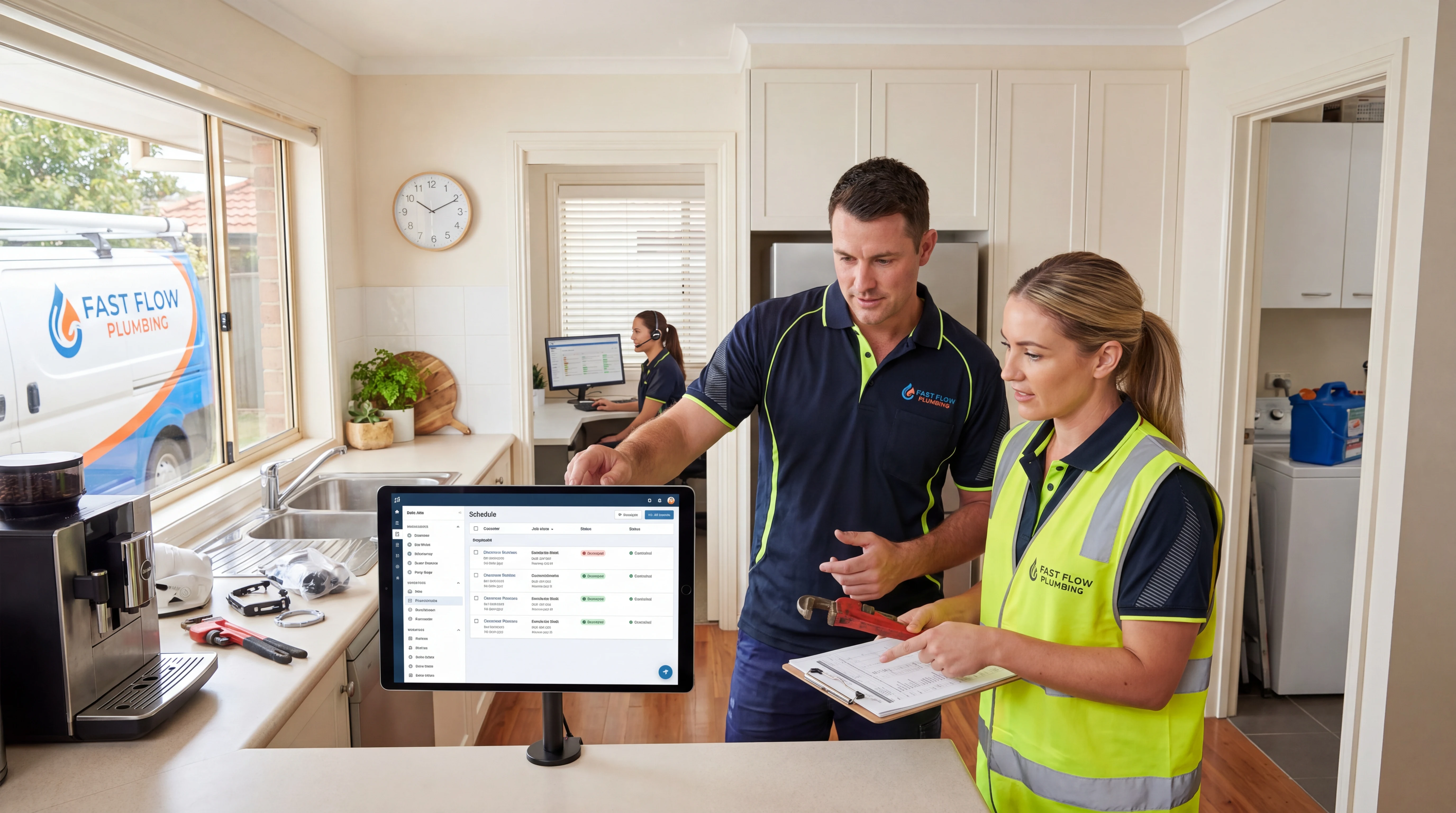
Workflow context for the article topic
Generated scene
Frequently Asked Questions
Sources