
Why this matters
Use this hub for ROI, implementation frameworks, office workflow improvements, and full-pipeline operating models.
Short Answer
For most HVAC companies, the strongest AI front desk ROI does not come from broad “AI for the office” promises. It comes from one specific workflow: capturing every inbound call and web lead, qualifying the job quickly, and moving the opportunity into a dispatch-ready booking flow tied to your field service management process.
That is the commercially sensible place to start because HVAC demand is uneven, urgent, and seasonal. When the phone spikes during a heat wave or cold snap, the value of an AI front desk is not abstract. It shows up in three measurable places:
- Seasonal volume impact: fewer missed opportunities during peak demand
- Speed-to-lead economics: faster response on calls and digital leads, especially after hours
- Operational leverage for the office: less repetitive intake and routing work for CSRs and dispatch staff
If a tool cannot connect those activities to booked jobs, cleaner handoffs, and lower admin strain, the ROI case is weak no matter how polished the feature list sounds.
For a broader category view of how teams frame this business case, see the AI Operations and ROI Hub.
Why HVAC ROI Looks Different From Generic “AI Receptionist” ROI
HVAC buying conditions are different from general small-business phone answering.
A restaurant, law office, or med spa may care most about appointment fill rate. An HVAC company usually has a more complex mix:
- emergency and same-day calls
- replacement opportunities
- tune-up and maintenance scheduling
- seasonal campaign surges
- geographic routing constraints
- technician capacity that changes by day and by service type
That means the ROI question is not just, “Can AI answer the phone?”
It is, “Can this workflow help us turn demand into the right booked jobs without creating more cleanup work for the office?”
A booked appointment that is missing equipment type, urgency, location details, or service category may look good on a dashboard but still create downstream friction. In HVAC, bad intake quality can break dispatch, waste technician time, or delay the response window enough to lose the customer anyway.
That is why HVAC owners should evaluate AI front desk ROI around booking quality and workflow fit, not just conversation coverage. The more your process depends on structured scheduling and dispatch logic, the more important FSM-integrated workflows become.
The Workflow to Prioritize First
If you are evaluating AI front desk ROI for HVAC, prioritize the workflow below before exploring broader automation.
1. Capture inbound demand across calls and web leads
The first job is simple: do not let high-intent demand disappear.
That includes:
- missed calls during peak hours
- after-hours inbound calls
- weekend inquiries
- web forms that sit too long before follow-up
- repeat callers who need fast triage
This is the highest-leverage use case because the buyer intent already exists. You are not trying to manufacture demand. You are trying to stop losing it.
2. Qualify for dispatch, not just for conversation
A generic AI front desk may sound polished but still fail the ROI test if it does not gather the information your office actually needs.
For HVAC, that typically means verifying details such as:
- customer identity and callback information
- address and service area fit
- equipment or system context, if available
- urgency level
- problem type, such as no cool, no heat, maintenance, estimate request, or other
- preferred timing or availability window
The point is not to over-automate diagnosis. The point is to collect enough information for the office to book, prioritize, or route the opportunity correctly.
3. Hand off into the FSM-connected workflow
This is where many ROI claims become fuzzy.
If the AI front desk captures inquiries but the office still has to re-enter details, fix categorization, or manually reconcile records, the labor savings may be smaller than expected. The best economic outcome usually comes when the intake flow connects cleanly to the existing operating system for scheduling, customer records, and dispatch.
That is why HVAC owners should keep the evaluation grounded in FSM-integrated workflows rather than judging the front end in isolation.
Seasonal Volume Impact Is the First Big ROI Lever
HVAC is defined by uneven demand. Shoulder seasons feel manageable. Extreme weather does not.
During peak periods, three things often happen at once:
- inbound volume rises sharply
- urgency increases
- office capacity does not expand fast enough
That makes missed-call loss and delayed follow-up disproportionately expensive.
An AI front desk can create ROI during those spikes by absorbing overflow, maintaining first-response coverage, and keeping intake moving when human staff are saturated. The value is not merely “more answered conversations.” The value is preserving bookable demand when the office is under pressure.
Peak-season math without guesswork
You do not need inflated projections to test this.
Build the case using your own operating data:
| ROI component | What to measure |
|---|---|
| Seasonal call overflow | Missed calls during peak weeks or peak hours |
| After-hours demand | Calls and web leads received outside live office coverage |
| Additional answered opportunities | Number of contacts now handled that were previously missed or delayed |
| Booking conversion | Percent of those opportunities that become scheduled jobs |
| Job value | Use your own average contribution or gross profit by service type |
| Office labor impact | Reduction in repetitive intake, callback, and rescheduling work |
This structure matters because HVAC seasonality can make an AI front desk look brilliant in July and unnecessary in October. The right question is not whether demand is always extreme. It is whether the system protects margin when demand surges and creates leverage when the office is stretched.
For teams building a broader operating case around those metrics, the AI Operations and ROI Hub offers related frameworks.
Speed-to-Lead Economics Matter More Than Most HVAC Owners Expect
HVAC buyers usually focus first on phone coverage, which makes sense. But speed-to-lead on digital inquiries matters too.
When someone fills out a form for no-cool service, second-opinion replacement, or maintenance, the clock starts immediately. Even if that prospect does not call a competitor right away, delay reduces intent quality. Someone else often responds faster, or the customer simply keeps searching.
Why minutes matter more than feature counts
An AI front desk workflow can improve economics if it helps your team:
- acknowledge demand immediately
- collect key triage details quickly
- present a booking path faster
- route urgent jobs without waiting for office backlog
- keep the customer engaged until a confirmed next step exists
That is why “speed-to-lead” should be treated as a revenue variable, not just a service metric.
For HVAC companies, faster response is especially valuable in these cases:
- after-hours emergency-ish calls that may still wait until morning if handled properly
- replacement or estimate requests that go cold when follow-up is slow
- maintenance leads generated through campaigns
- weather-driven spikes when customers contact multiple providers
The commercial logic is straightforward: the shorter the gap between inquiry and qualified response, the lower the chance that demand leaks away.
Operational Leverage for the Office Is the Second Big ROI Lever
The other major ROI driver is not top-line growth alone. It is what happens inside the office.
A well-scoped AI front desk can reduce pressure on CSRs, office managers, and dispatch coordinators by handling repetitive intake work consistently. That does not mean replacing judgment-heavy tasks. It means offloading the parts of the interaction that are structured and repeatable.
What “office leverage” should mean in practice
Operational leverage should show up as improvement in tasks like:
- answering or triaging overflow conversations
- gathering baseline customer and service details
- creating cleaner intake notes
- reducing repetitive callbacks for missing information
- routing non-urgent inquiries without interrupting dispatch activity
- standardizing the first touch across peak and after-hours periods
If the office still has to do the same work plus correct the AI’s output, the leverage is not real.
That is why HVAC owners should ask a blunt question during evaluation: Which admin steps disappear, which ones shrink, and which ones stay fully manual?
If that answer is vague, the ROI case is probably vague too. For HVAC-specific context on how office load interacts with field capacity, visit the HVAC page.
Where AI Front Desk ROI Actually Comes From
The financial case usually comes from a combination of recovered demand and labor efficiency.
Here is a practical way to think about it:
| ROI source | Typical HVAC mechanism | What to verify |
|---|---|---|
| More answered opportunities | Overflow and after-hours coverage | How many contacts are newly handled |
| Higher booking volume | Faster qualification and scheduling | Booking rate by lead source and job type |
| Better booking quality | Cleaner intake before dispatch | Fewer bad appointments or rework |
| Lower cost to book | Less manual intake and callback time | Time saved per booked job |
| Office capacity relief | Staff spends less time on repetitive triage | Whether admin effort actually declines |
This framework helps prevent a common mistake: counting every handled conversation as value.
Some conversations are low-intent, out of area, or non-bookable. That is normal. The goal is not maximum activity. The goal is efficient conversion of valid HVAC demand into workable appointments.
A simple ROI formula
A practical estimate looks like this:
ROI = recovered gross profit from additional booked jobs + labor savings from reduced admin work - software and implementation cost
Use your own numbers for:
- missed or delayed opportunities recovered
- booking rate on those opportunities
- average contribution by service type
- hours of CSR or dispatcher time reduced
- subscription, setup, and integration costs
That produces a more credible business case than generic automation claims.
What to Verify in FSM-Integrated Workflows
This is the make-or-break section for most buyers.
The available evidence on this category is limited and largely vendor-published, so treat product claims as inputs, not proof. Verify pricing, setup effort, integration depth, and booking accuracy in your own environment before treating any platform as the right fit.
Booking rules and availability logic
Ask how the workflow handles:
- service categories
- same-day vs non-urgent scheduling
- geographic constraints
- business hours vs after-hours routing
- maintenance vs repair vs estimate intake
If the logic is rigid, shallow, or unclear, you may get more conversations but not better bookings.
Data sync and record ownership
You need to know:
- whether customer records sync automatically
- whether notes are written back in a usable format
- whether duplicate records are likely
- whether call and form activity can be tied to a job record
- who owns the source-of-truth data when edits happen
These details are often under-documented in top-level marketing materials, so they need direct confirmation.
Dispatch handoff and exception handling
Not every interaction should auto-book.
HVAC workflows need exception paths for:
- out-of-area leads
- emergency escalation
- capacity limits
- incomplete customer information
- financing or replacement follow-up
- callbacks that require a human decision
A strong implementation is not just automation. It is automation with clear human handoff points. If the handoff cannot support your actual scheduling process, the promise of FSM-integrated workflows is not yet proven.
Implementation Checklist for HVAC Owners
A controlled rollout will usually produce a more believable ROI result than a broad launch.
Before launch
Define the first workflow narrowly:
- after-hours call handling
- missed-call recovery
- web lead qualification
- overflow booking during peak periods
Then document your baseline:
- missed call rate
- average response time
- booking rate
- admin time spent on intake
- booked jobs from after-hours and digital channels
Also define what counts as success. For example:
- more valid appointments booked
- faster first response
- less manual intake per opportunity
- no increase in dispatch errors or bad appointments
During the first 30 to 60 days
Run a simple operating review:
- Which inquiries were captured that were previously lost?
- Which booked jobs were clean and dispatchable?
- Where did the office still have to intervene?
- Did speed-to-lead improve?
- Did office workload actually shift, or just move around?
If your analysis cannot answer those questions, you do not yet have an ROI system. You have activity without proof.
Teams that want a category-specific implementation example can review Get Your Free AI Front Desk and compare it against their own workflow requirements.
Metrics to Track
A good HVAC AI front desk scorecard should be compact and operational.
Core ROI scorecard
Track these metrics first:
- Answer rate or contact coverage
- Missed-call recovery rate
- Speed to first response
- Booking rate from handled opportunities
- Booked jobs by service type
- Cost to book
- Admin time per booked opportunity
These tell you whether the system is producing real throughput gains.
Quality controls
You also need guardrails:
- bad appointment rate
- duplicate record rate
- dispatch correction rate
- customer complaint rate tied to intake
- human takeover rate
- out-of-area or non-serviceable inquiry rate
Without quality controls, ROI can be overstated.
For example, a higher booking rate is not a win if dispatch has to repair half the appointments. Broader scorecard thinking for these kinds of systems is covered in the AI Operations and ROI Hub.
How Related Queries Map Back to the Same Buying Decision
The related searches around this topic are really asking the same core question.
“AI front desk ROI for home service businesses”
This broader query still comes back to workflow design. For HVAC, the answer should be narrower and more operational: use AI where it directly affects booked jobs, response quality, and office leverage. Generic home service advice is often too broad unless it accounts for HVAC seasonality and dispatch requirements.
“How to add AI to a home service business”
The best starting point is not “add AI everywhere.” It is “add AI where demand already exists and the handoff can be measured.” For HVAC, that usually means inbound intake, qualification, and booking support before expanding into broader back-office automation.
“ServiceTitan AI workflow automation”
This query points to the same concern: buyers want to know whether AI can work inside an established operating system. From the current evidence set, there is not enough detail to assess specific ServiceTitan AI workflow claims here. The right buyer move is to verify whether any vendor can support your actual booking, note capture, scheduling, and dispatch handoff rules inside the FSM environment you already use.
What Current Vendor Evidence Does and Does Not Show
The currently available evidence is useful for context, but it is not enough to crown a vendor.
Scorpion describes itself as an agency-led marketing platform for home service businesses and references integrations across areas such as ads and CRM. Housecall Pro describes itself around software for home service businesses. Those examples show the market pressure to connect demand generation, customer records, and field operations. They do not clearly establish AI front desk pricing, implementation effort, booking accuracy, HVAC-specific workflow depth, or measured ROI outcomes for your company.
So the buying decision should remain category-first:
- Can the system capture peak and after-hours demand?
- Can it qualify for HVAC dispatch needs?
- Can it hand off into the FSM workflow with minimal friction?
- Can it improve answer rate, booking rate, speed to lead, and office efficiency in a way you can measure?
If a vendor cannot answer those questions clearly, brand familiarity alone is not enough.
Common ROI Mistakes HVAC Owners Should Avoid
A few patterns regularly distort AI front desk evaluations.
Starting with feature demos instead of workflow economics
If you begin with voice quality, summaries, or novelty features, you may miss the real question: does this improve booked-job flow?
Treating all leads as equal
No-cool, tune-up, replacement, and warranty calls do not have the same urgency or value. Track by job type where possible.
Ignoring after-hours and overflow data
That is often where the cleanest ROI appears.
Measuring conversation volume instead of booking quality
More interactions are not the goal. Better scheduled outcomes are.
Overlooking office rework
If the office spends more time correcting intake, the labor savings can disappear.
For a neutral category overview of HVAC operating context, see HVAC.
Final Recommendation
If you are evaluating AI front desk ROI for HVAC companies, start with one narrow, high-value, FSM-connected workflow:
capture missed and after-hours demand, qualify it for HVAC dispatch, and move it into a clean booking process that the office does not have to rebuild manually.
That is the fastest path to a defensible business case because it ties directly to:
- seasonal volume impact
- speed-to-lead economics
- operational leverage for the office
Do not approve a platform on generic AI positioning alone. Approve it only if the workflow can be tested against your real operating data and answer these questions with clarity:
- Did we recover demand we used to miss?
- Did more of that demand become valid booked jobs?
- Did response time improve?
- Did the office gain usable capacity?
- Did dispatch quality stay intact or improve?
If those answers are yes, the ROI case is strong. If those answers are uncertain, keep the evaluation focused on workflow proof rather than vendor promises.
If you want to compare one example in this category against your own requirements, Get Your Free AI Front Desk is available as a starting point. Before choosing any platform, confirm integration scope, setup requirements, booking rules, and how success will be measured against your HVAC workflow.
Supporting visuals
Visual proof and context
Screenshots and images that support this article, with sources noted.
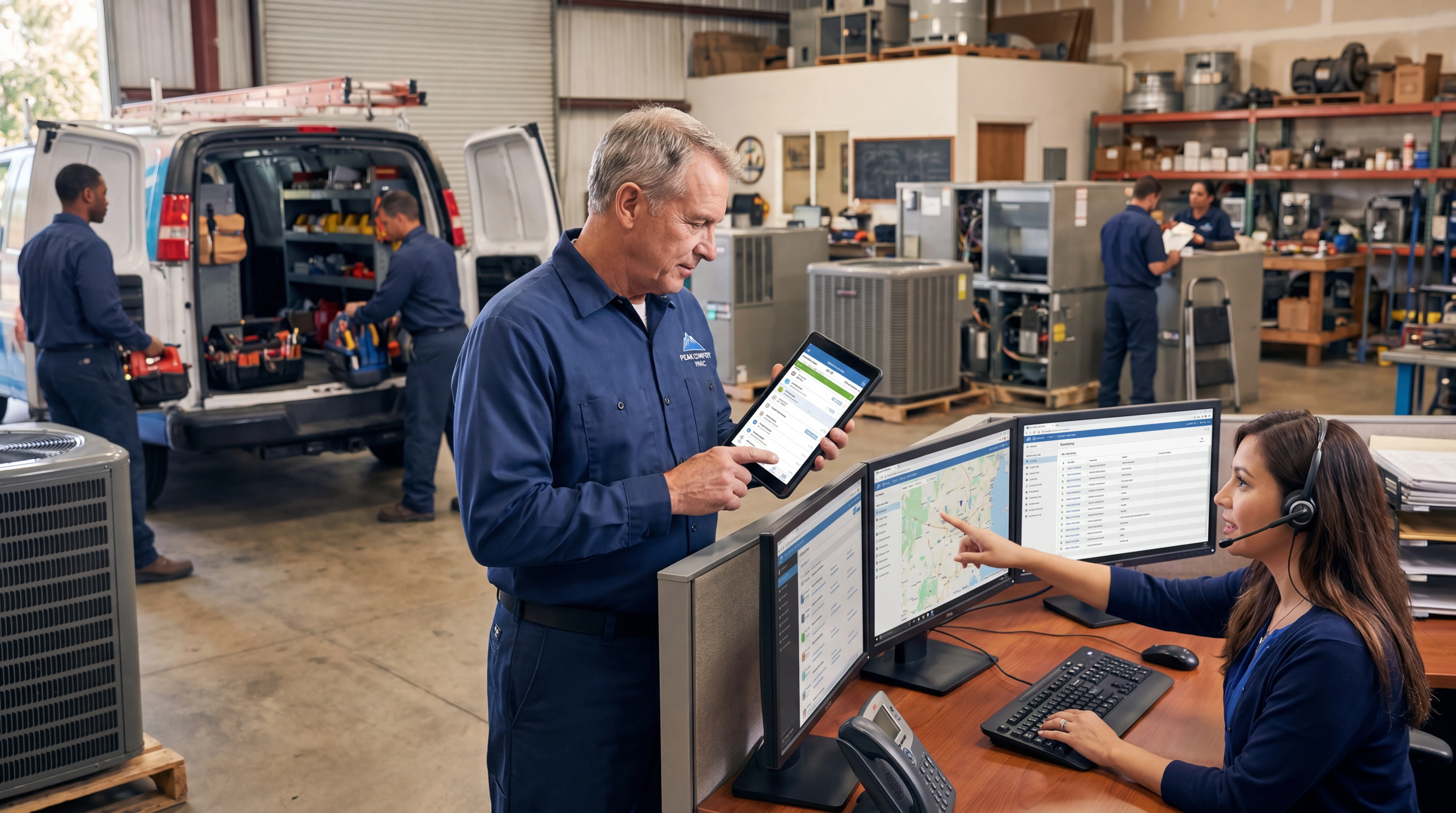
Workflow context for the article topic
Generated scene
Frequently Asked Questions
Sources