Why this matters
Cover the exact workflows that move a qualified lead from first contact to a booked appointment without double entry or staff bottlenecks.
Short Answer
Landscaping owners should prioritize an AI triage workflow that separates urgent irrigation or property-risk calls from routine quote and maintenance requests at first contact, then books or routes the next step inside the system the office already uses.
That direction is commercially sensible because most landscaping teams do not need a full emergency-dispatch motion for every inbound call. They need a cleaner intake layer that can do three things reliably:
-
Identify urgency quickly Examples include an irrigation line break causing active water loss, drainage overflow creating property risk, or storm debris blocking access.
-
Route the call to the correct follow-up path Urgent property issues should trigger same-day human review or on-call escalation. Routine estimate requests should go to normal booking or next-business-day follow-up.
-
Send immediate SMS expectation-setting The caller should know whether they are booked, queued for review, or waiting for a business-hours callback.
If a tool cannot distinguish those paths and hand them into your calendar or field workflow without double entry, it adds friction instead of removing it. For broader context on adjacent intake and scheduling decisions, see the Booking and Scheduling Hub.
Why This Problem Matters
Landscaping companies get a mixed stream of inbound demand:
- new quote requests
- recurring maintenance questions
- irrigation repair calls
- drainage complaints
- storm cleanup requests
- after-hours voicemails from property managers
- existing-customer follow-ups
When seasonal quote volume rises, truly urgent property issues can get buried under normal sales inquiries. That creates direct operational risk:
- missed same-day revenue opportunities
- slower response on jobs where damage can worsen
- more office interruptions
- more manual call review
- more rekeying between phone notes, calendars, and field systems
The goal of emergency call triage for landscaping companies is not to make every caller feel like they reached a 911 desk. It is to protect response quality for the smaller set of calls that actually need faster handling without slowing down the much larger volume of routine demand.
That distinction matters because over-escalating normal landscaping calls is expensive. If every “I need a quote for trimming and mulch” lead gets treated like urgent dispatch, the office loses efficiency fast. If every irrigation leak gets pushed into a general callback queue, response quality suffers.
What Actually Counts as Urgent in Landscaping
Not every landscaping issue is urgent, but some clearly need faster review than a routine estimate.
Irrigation and water-loss issues
Common urgent examples include:
- a broken irrigation line causing continuous water flow
- a malfunctioning valve or zone flooding turf, beds, or walkways
- sprinkler damage creating pooling near building entries
- water loss affecting commercial properties with tenant or visibility concerns
These are strong candidates for urgent routing because delay can increase damage, water waste, and customer frustration.
Property-risk issues
Property-risk calls may also deserve accelerated follow-up, such as:
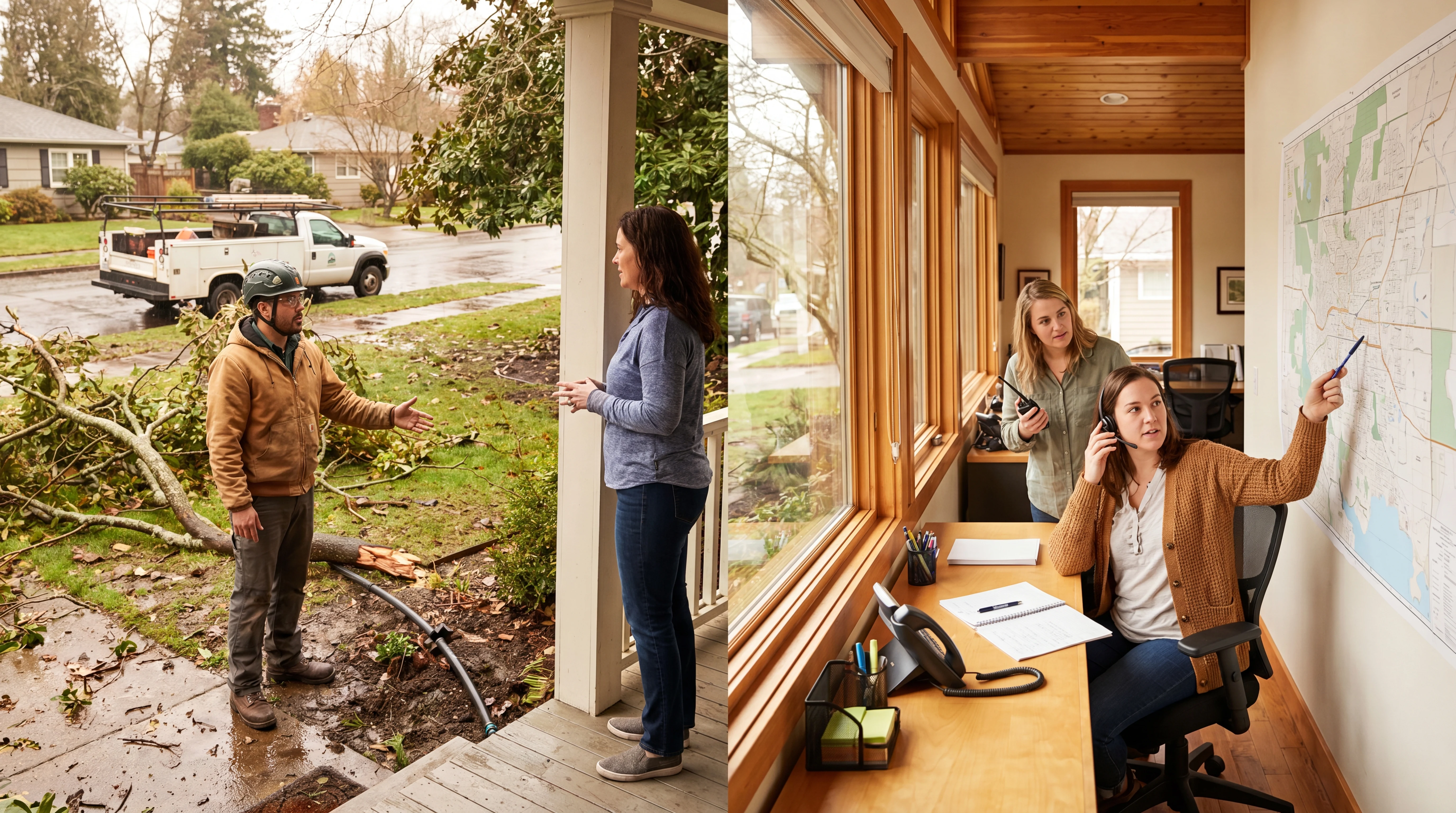
- storm debris or a fallen limb blocking access
- washout or erosion threatening a path, edge, or visible landscape area
- drainage overflow affecting usability or creating slip concerns
- damage at a managed property where the customer expects immediate acknowledgement
The threshold should be set by the landscaping business, but the triage logic should reflect real business risk rather than vague “emergency” language.
What should stay in the routine lane
Most landscaping inquiries should still route through normal booking:
- design consultations
- seasonal cleanup requests
- weekly or biweekly maintenance quotes
- planting, mulch, sod, or enhancement estimates
- non-urgent irrigation tune-ups
- general proposal follow-up
That is why the right workflow does not simply ask, “Is this an emergency?” It asks enough structured questions to determine whether the issue is property-risk now, service needed soon, or standard quote demand.
What Strong Solutions Need to Do
The available evidence here comes mostly from vendor materials rather than independent testing, and pricing, setup depth, and landscaping-specific scripting are not consistently documented. That makes workflow proof in demo more important than brand-level positioning.
Capture intent in plain language
Callers rarely use neat categories. They say things like:
- “One of our sprinkler lines blew out.”
- “Water has been running for an hour.”
- “A big branch is down across the driveway.”
- “I just want a quote for weekly mowing.”
A strong system has to map those statements into useful operational categories. For landscaping, that usually means:
- urgent irrigation
- urgent property issue
- routine repair request
- routine quote request
- existing-customer follow-up
Route without double entry
If the office still has to listen to recordings, rewrite notes, and manually create appointments, the triage layer is not doing enough. The point is to place qualified intake into the next system step:
- booked estimate
- task for same-day callback
- urgent service review
- dispatch queue
- customer communication thread
If you are comparing broader intake automation options, the AI booking overview is a useful reference for how call-to-calendar routing typically works.
Support real escalation rules
Landscaping buyers should look for escalation logic such as:
- after-hours urgent calls alert on-call staff
- routine quotes stay in a next-business-day queue
- existing customers can be prioritized differently from new leads
- commercial properties can follow different urgency rules than residential
Confirm expectations by SMS
The customer should not wonder what happens next. A fast text message reduces repeat calls and sets the right service expectation.
That matters especially when the answer is not immediate dispatch. Landscaping companies often need a realistic middle ground between “we booked you” and “we heard you and a human will review this quickly.”
Recommended Workflow for Emergency Call Triage
For most landscaping companies, the workflow to prioritize is:
- AI intake answers first contact
- System identifies urgent vs routine
- Urgent issues route to same-day human review or on-call escalation
- Routine estimates route to normal booking
- Caller receives an SMS confirming the path
- Job, lead, or task lands in the calendar or FSM without rekeying
That workflow protects response quality on urgent issues while preserving office efficiency during heavy quote volume.
Step 1: Collect the minimum useful detail
The intake should capture:
- caller name
- address or property
- issue type
- whether damage is active now
- whether the caller is an existing customer
- preferred callback details
For landscaping, “minimum useful detail” beats long conversational intake. The office needs enough information to decide the path, not a ten-minute interview.
Step 2: Split urgent follow-up from normal scheduling
A practical split looks like this:
Urgent follow-up path
- active irrigation leak
- flooding or water loss
- storm debris affecting access
- property-risk complaint needing same-day review
Routine path
- quote request
- maintenance inquiry
- non-urgent repair
- seasonal services
- enhancement consultation
Step 3: Book or escalate with a defined owner
Every route needs an owner:
- the calendar books routine estimates
- the office team owns normal callbacks
- the on-call lead owns after-hours urgent review
- dispatch or service coordination owns same-day field response when applicable
If the workflow stops at “we took a message,” it is not good triage.
Routine Quote Requests Versus Urgent Follow-Up Routing
This is the core split landscaping owners should get right.
A caller asking for weekly lawn service, mulch refresh, hedge trimming, or a spring cleanup should usually move through standard quote handling. That may mean a booking link, a scheduled estimate, or a business-hours callback.
A caller reporting active water loss or a property issue with immediate consequences should move through accelerated follow-up. That does not always mean a truck is instantly dispatched. It means the company has acknowledged the issue, applied its urgency rules, and assigned the right response lane.
A clean routing model often looks like this:
- Routine quote → estimate appointment or sales follow-up
- Routine repair → service callback queue
- Urgent irrigation → same-day review, with on-call handoff after hours if needed
- Property-risk issue → priority callback or dispatch review
- Existing-customer issue → possibly prioritized over new lead intake
Many generic answering setups can collect a message, but they do not always convert it into the right operational object: a booked estimate, a dispatch-ready job, or a flagged urgent task. That is why landscaping teams evaluating AI booking workflows should focus on routing logic, not just whether a system answers the phone.
How Calendar and FSM Integrations Change the Decision
Integration matters because triage quality is only half the job. The other half is what happens after the call.
ServiceTitan positions itself as a field service management platform for dispatch, scheduling, and customer workflows. Housecall Pro positions itself as a field service management platform for scheduling, dispatch, invoicing, and customer communication.
For a landscaping buyer, that means the practical value of an AI triage layer depends on whether it can hand off cleanly into the system already running the office.
If you use ServiceTitan
The key question is not whether ServiceTitan can support scheduling and dispatch workflows in general. It is whether the AI intake layer can:
- create or support the correct job type
- pass urgency notes accurately
- avoid duplicate manual entry
- keep office staff from reworking the lead
That is the real meaning behind searches like service titan ai booking assistant. Buyers are usually not looking for AI in the abstract. They are trying to find an intake layer that books and routes correctly inside their existing operating system.
If you use Housecall Pro
The same logic applies. Housecall Pro already centers scheduling, dispatch, invoicing, and customer communication. So the buying question becomes:
- can the AI layer qualify the landscaping call correctly?
- can it push the record into Housecall Pro cleanly?
- can it preserve notes the office and field teams actually need?
If you are not deeply committed to an FSM yet
Some smaller landscaping companies run lighter scheduling stacks. In that case, evaluation should focus even more on:
- booking accuracy
- flexibility of routing rules
- SMS confirmations
- ease of setup
- what still has to be done manually after intake
For more category background, the Booking and Scheduling Hub covers related scheduling decisions beyond this specific landscaping use case.
Examples From the Current Evidence Set
These are examples from the current source set, not a complete market shortlist.
Sameday
Sameday describes itself as an AI receptionist and scheduling product for home service businesses. In the supplied evidence, it also lists integrations with ServiceTitan and Housecall Pro.
That makes it relevant to this buying decision because emergency call triage for landscaping companies is largely an AI receptionist + scheduling + system handoff problem. If your business already runs ServiceTitan or Housecall Pro, a documented integration is more useful than a standalone answering layer.
What to verify in a demo:
- landscaping-specific urgency rules
- handling of irrigation leak language
- after-hours routing behavior
- how routine quote requests get booked
- what data passes into the downstream system
ServiceTitan
ServiceTitan describes itself as a field service management platform for dispatch, scheduling, and customer workflows.
That matters because many landscaping owners searching for triage software may actually need better intake behavior on top of an existing FSM, not a replacement for the FSM itself. ServiceTitan can be the operating backbone, but buyers should still confirm how the intake layer writes urgency, notes, and booking outcomes into it.
Housecall Pro
Housecall Pro describes itself as a field service management platform for scheduling, dispatch, invoicing, and customer communication.
For landscaping businesses already using Housecall Pro, the key question is whether the AI triage layer makes Housecall Pro more useful at first contact. The ideal outcome is that urgent follow-up and routine estimate paths are created correctly without office staff rebuilding the conversation manually.
AgentZap
AgentZap describes itself as AI receptionist software, and its source set includes plumbing-specific answering and dispatch positioning. It also states integrations with ServiceTitan, Housecall Pro, and Jobber.
That makes it relevant as a workflow example, but not a landscaping recommendation by itself. Because the documented positioning is plumbing-specific, landscaping buyers should verify whether it can be configured for irrigation and property-risk scenarios before treating it as a likely fit.
How Related Searches Map Back to the Same Buying Decision
Searches like ai appointment scheduling for home service contractors and service titan ai booking assistant often sound broader than emergency call triage for landscaping companies, but they lead back to the same core decision:
Can the system move an inbound contact from first conversation to the right booked or escalated outcome without office bottlenecks?
That includes:
- understanding the caller’s intent
- distinguishing urgency from normal demand
- booking the right appointment type
- pushing data into the schedule or FSM
- notifying the customer what happens next
So if you came into this topic through a general AI scheduling search, the landscaping-specific requirement is simple: your intake layer must understand irrigation and property-risk urgency, not just generic home service appointment logic. If you want the trade-specific lens on that problem, the landscaping industry page provides additional context.
SMS Expectation-Setting Matters More Than Most Buyers Think
SMS is not just a courtesy. It is part of the triage workflow.
Without expectation-setting, customers call back, leave repeated messages, and create more office traffic. With clear SMS communication, you reduce uncertainty and reinforce the selected response path.
For urgent irrigation or property-risk issues
A good confirmation text should say:
- the issue was received
- the team is reviewing the request
- the customer should expect a callback or update within the company’s stated response window
- any safe immediate action the customer can take, if appropriate
A simple format might look like this:
We received your irrigation or property issue report for [address]. Our team is reviewing it now and will contact you within our urgent response window. If it is safe to do so, you may shut off irrigation water to reduce further loss.
For routine quote requests
A different template keeps expectations accurate:
Thanks for contacting [Company]. We received your request for a landscaping quote at [address]. We’ll follow up during business hours to confirm details and scheduling.
For booked estimate appointments
The text should confirm:
- appointment type
- date or timeframe
- what the customer should prepare, if anything
This is one reason the triage and booking layers should work together. If the intake can classify the call but cannot trigger the right confirmation flow, the customer experience still breaks. That connection between intake and confirmation is a core part of effective AI booking.
Buyer Checklist Before You Sign
A landscaping owner evaluating emergency call triage should ask vendors or internal teams these questions:
Triage logic
- Can it separate urgent irrigation calls from quote requests?
- Can it identify property-risk situations without overclassifying normal work as urgent?
- Can it handle existing customers differently from new leads if needed?
Booking accuracy
- Does it create the correct appointment type?
- Can it book estimates separately from service follow-up?
- How does it prevent bad fits from landing on the calendar?
System handoff
- Does it integrate with ServiceTitan, Housecall Pro, or your current scheduling stack?
- What notes, tags, or call outcomes pass through?
- Where does manual re-entry still happen?
Escalation rules
- What happens after hours?
- Who gets alerted for urgent issues?
- Can different properties or customer types follow different rules?
SMS communication
- Are confirmation texts sent automatically?
- Can urgent and routine messages use different templates?
- Can the customer clearly tell whether they are booked or awaiting review?
If a vendor cannot walk through those questions with landscaping examples, the fit is uncertain.
Common Mistakes Landscaping Buyers Make
Shopping for “emergency dispatch” when the real need is triage
Most landscaping teams do not need every call treated like a same-minute dispatch event. They need a reliable urgent-versus-routine intake process.
Buying a generic answering layer that still creates office work
Some systems sound capable but still leave staff to:
- interpret urgency manually
- recreate appointments
- chase missing property details
- explain next steps one by one
Ignoring seasonal quote surges
In many landscaping businesses, routine estimate volume is what creates the triage problem in the first place. If the workflow does not protect urgent property issues from that volume, it misses the commercial point.
Final Recommendation
For emergency call triage for landscaping companies, prioritize a workflow that:
- identifies urgent irrigation and property-risk issues at first contact
- routes routine quotes and maintenance requests into standard booking
- applies clear escalation rules for same-day or after-hours review
- sends immediate SMS expectation-setting
- writes the outcome into your calendar or FSM without double entry
If you already run ServiceTitan or Housecall Pro, start with AI receptionist and booking tools that document those integrations, including examples like Sameday from the current evidence set. If you are earlier in your stack or operating with lighter scheduling tools, put even more weight on booking accuracy, confirmation flows, and the amount of manual work left after intake.
The right choice is the one that can prove, in a landscaping-specific demo, that it handles these two paths cleanly:
- Routine quote request → booked estimate or standard follow-up
- Urgent irrigation or property-risk issue → priority review or escalation with clear customer communication
That is the practical buying decision behind both emergency call triage for landscaping companies and related searches around AI appointment scheduling. If a system cannot show that split clearly, it is not ready to improve booked jobs, response quality, or office leverage.
Supporting visuals
Visual proof and context
Screenshots and images that support this article, with sources noted.

Source-backed evidence from www.gosameday.com
Captured evidence
SourceFrequently Asked Questions
Sources